Agency update: Family Nurture Care in the Neonatal ICU
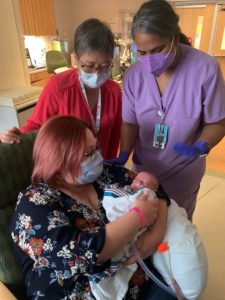
Imagine that your first experience of the world is one where touch often means discomfort. That’s the world of babies in neonatal ICUs, who regularly require painful procedures.
It’s also a world where parents may struggle to understand how to interact with their baby, so tiny and hooked up to a variety of machines. That’s where the Family Nurture Care program in the Level IV Neonatal Intensive Care Unit (NICU) at University Hospital comes in. That program, provided through partnership with UT Health San Antonio and the Columbia University Nurture Science Program, received a 2021 Support Grant from Impact San Antonio that funded its operation for a month last year.
In addition, a generous donation from an anonymous Impact SA member allowed the program to be funded for an additional year.
“An Impact San Antonio member was inspired by our presentation on this program (at Grant Award Night in 2021) and decided to give through her family foundation,” said Stephanie McClain, senior director of corporate and foundation relations for UT Health San Antonio.
Through the program, nurses are trained as nurture specialists and show parents — usually mothers, although fathers are equally welcome and important — how to hold and interact with their fragile, sick babies.
“It’s vital to ensure that the babies strengthen their emotional connection with their parents, which has lifelong implications,” said Dr. Umber Darilek. She is a post-doctoral research fellow at UT Health and studies the Family Nurture Care program along with Dr. Alice Gong.
“When a healthy baby is born, there is usually some uninterrupted time with Mom,” Darilek said. “But when a baby is born sick or premature, they are immediately separated, and that opportunity to bond outside of the womb is interrupted due to medical necessity when baby is taken away to the NICU. This is traumatic for both baby and parents. The baby is going through painful procedures, not experiencing positive touch and interaction with their parents.
“For the moms, this can be terrifying,” Darilek continued. “We primarily see moms feeling guilty because they think they are somehow at fault because their baby is in the NICU, which we know is not true. Despite having many highly skilled people caring for the baby, the NICU staff cannot provide the baby’s need for their parents’ touch, voice, smell and love.”
“Knowing how to hold your baby when you’re dealing with all the wires and tubes makes a huge impact on the child’s and parent’s ability to bond emotionally,” McClain said. “The parent learns how to talk to their baby and strengthen their connection. The baby learns the parent’s voice and receives love through multisensory interaction coupled with emotional expression.”
The nurture care concept was developed by Dr. Martha Welch at Columbia University in New York, Darilek said. UT Health and University Health used their research as a springboard to create this program at the University Hospital NICU.
So far, in Texas it is only being offered at University Hospital, but staff are hoping that it will expand to other hospitals with NICUs. A key factor is showing how the program will ultimately save money by improving care and reducing the length of hospital stays, Darilek noted.
So far, the program has worked with 832 families, and most are seen more than once, she said. Feedback from parents has generally been positive, she said.
“They are very grateful,” she said.
To see a video of the 2021 Grant Award Night finalist presentation about the program, click here.